Angebot anfordern
Nennen Sie uns Produkttyp, Menge, Logoanforderungen, Verpackungswünsche und Zielland. Unser Team antwortet innerhalb von 12 Stunden, um Ihre Anforderungen und das Großhandelsangebot zu besprechen.
Nylon vs polyester paracord for wholesale: compare stretch, UV, floating and cost, plus where PP fits. Pick the right 550 cord, then get a quote.
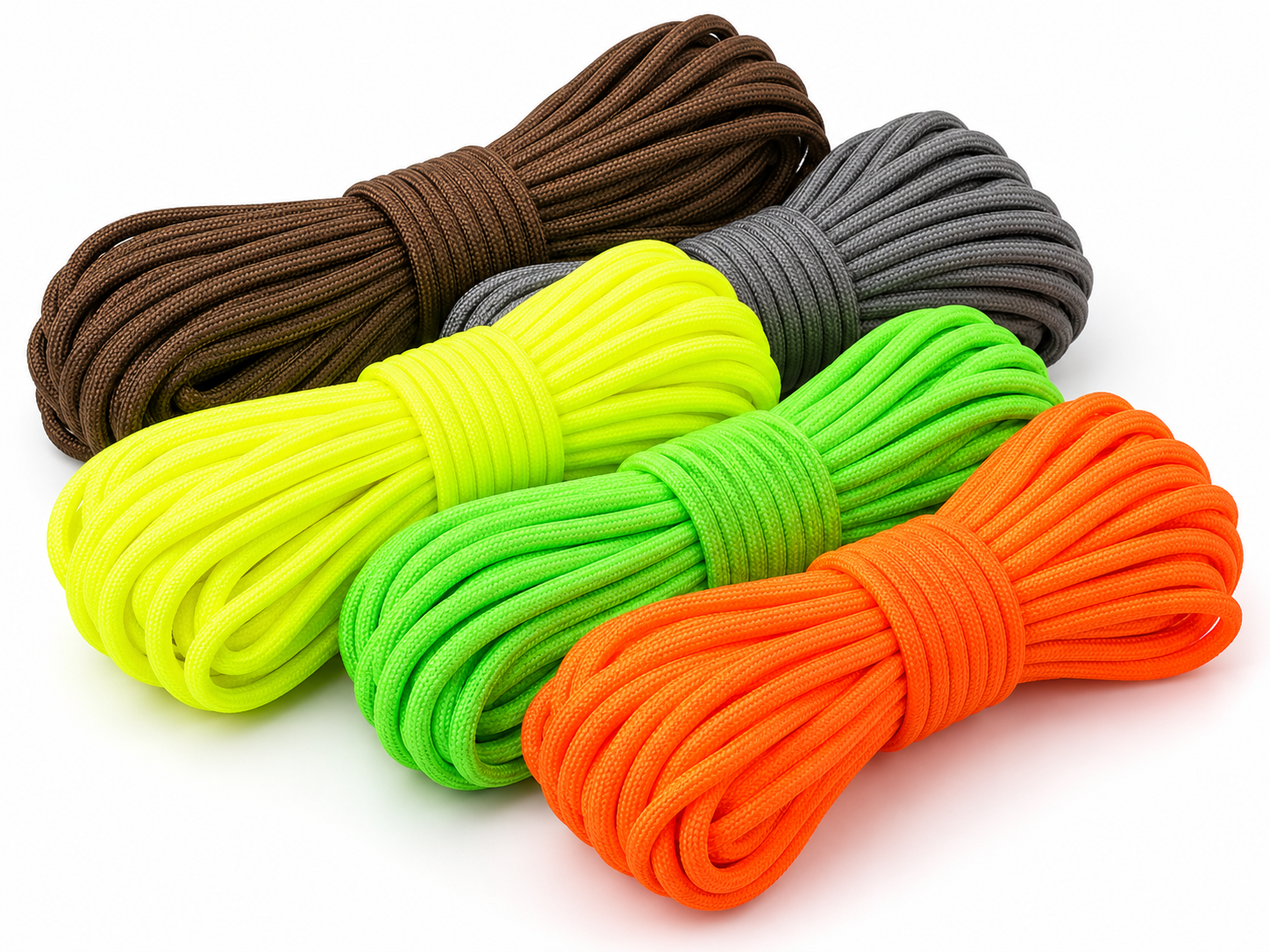
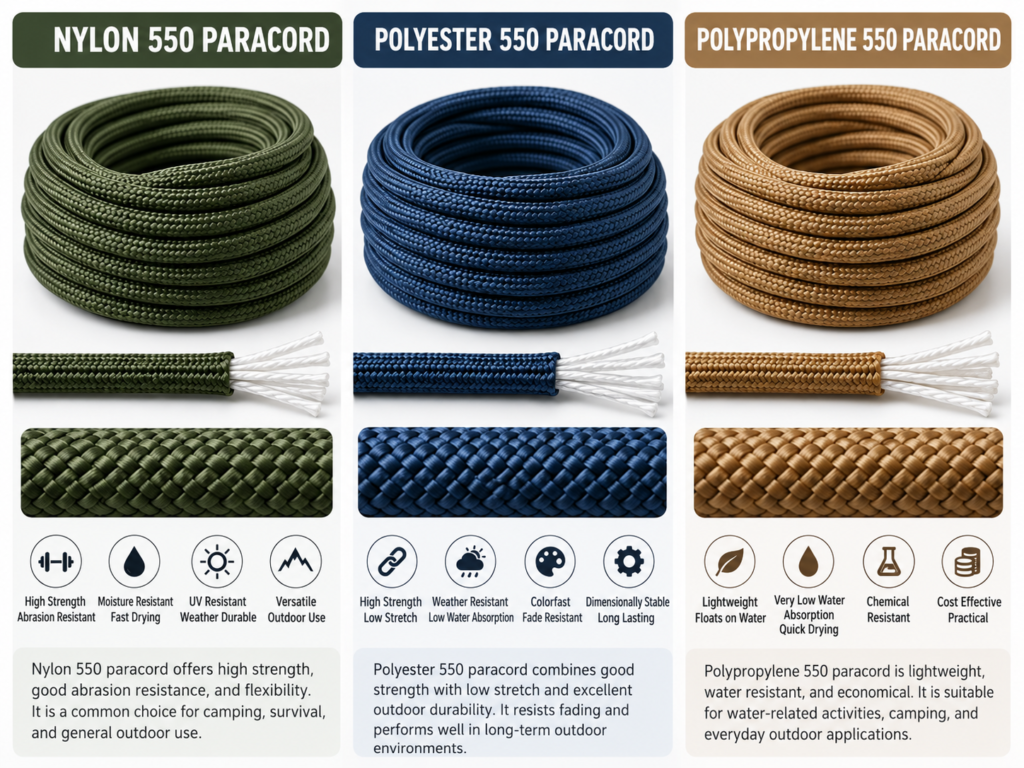
On a colour card, nylon, polyester and polypropylene 550 Paracord can look almost the same. In a buyer’s hands they behave differently. One stretches more, one holds its shape, one floats. This guide is for wholesale buyers who need to pick a fibre for a real order.
Nylon paracord stretches more and has the classic soft feel. Polyester paracord stretches less and keeps its colour well outdoors. Polypropylene paracord is the lightest, floats on water and suits cost-sensitive orders. Our 550 paracord is 550 lb rated in nylon, polyester and polypropylene.
| Nylon | Polyester | Polypropylene (PP) | |
| Stretch | High | Low | Medium |
| In water | Sinks | Sinks | Floats |
| Colour hold in sun | Medium | High | Medium |
| Heat-seal ends | Good | Good | Good, melts faster |
| Hand feel | Soft, springy | Firm, slightly matte | Light, a little waxy |
| Relative cost | High | Medium | Low |
| Typical wholesale use | Classic bracelets, outdoor retail | Bag straps, outdoor gear, low-stretch uses | Bracelets, keychains, retail hanks, water-side uses |
Looking for a reliable paracord manufacturer for your brand?
Compare factory pricing, MOQ options, and customization details before you commit.
All three types use the same idea: a braided outer sheath over inner core strands. I won’t repeat it here. Our guide to sheath and core construction covers it, and how paracord is made shows the steps.
The 550 name comes from MIL-C-5040H, Type III. That is where the label started, nothing more. Many buyers assume 550 means seven-strand nylon only. It doesn’t. Polyester and polypropylene cords can reach 550 too, and our 550 paracord is 550 lb rated in nylon, polyester and polypropylene. More on the number in what 550 means in paracord und the different grades of paracord.
Not every cord is one fibre. A nylon sheath over a polyester core is a common build. It is still 550 lb rated. We make mixed cord to order; there is no stock.
Nylon is the fibre most people picture when they hear “paracord”. It has more give than the other two, so it feels springy and absorbs sudden pulls well. Wet nylon feels a bit softer and can stretch a little more. For most bracelet and retail uses, that’s fine. Some buyers like it.
Choose nylon when your customers expect the classic feel, or when the product sells into outdoor retail where “nylon” on the label matters.
Two things to plan for. Nylon costs more than PP. And at Survfire, nylon paracord in 4–10 mm is custom only, made to order, with no stock. Read more about whether paracord stretches und whether 550 paracord can get wet.
Polyester stretches less. If a strap, tie-down or handle should keep its length under load, polyester is the safer pick. It also holds colour well in strong sun, which matters for gear that lives outdoors.
On the same colour card, polyester can look a touch more matte or slightly deeper than nylon. Treat that as a hand-feel note, not a test result. Always check a sample.
Thin cords are polyester territory. Our 2–3 mm paracord is polyester. 550 polyester paracord is still available, made to order with no stock.
Polypropylene (PP) is the lightest of the three and it floats. It is also the most cost-friendly, which is why it fits big bracelet runs, promotional keychains and retail hanks.
Is PP “real” paracord? Honest answer: it is a different fibre in the same 550 build, and our PP 550 paracord is 550 lb rated. If your buyer only wants nylon on the label, PP isn’t the answer. If they want the look, the colours and a lower cost, it often is.
Our stock: we keep 4 mm+ paracord in colour-card stock colours, and our main product on the site is 4 mm paracord. For most first orders, that is where I’d start.
| Produkt | Usual pick | Why |
| Bracelets, keychains | PP or nylon | PP for cost; nylon for the classic feel |
| Dog leashes and collars | Polyester or nylon | Polyester for low stretch; nylon for a softer pull |
| Bag straps, handles | Polyester | Keeps length and colour |
| Water-side gear | PP | Floats |
| Retail hanks and spools | PP | Light and cost-friendly |
| Factory bulk for your own braiding | Depends on the end product | Match the fibre to what you sell |
For bracelet choices, see which paracord is best for bracelets. If you’d rather buy finished goods, we make braided paracord accessories, and woven bracelets and accessories start at 50 pcs per item. The custom paracord OEM guide explains the process.
This is the part buyers ask about most, so I’ll keep it plain.
Our stock paracord comes in colour-card colours. Polyester and nylon are dyed to order. You can match to a card colour or send a Pantone reference.
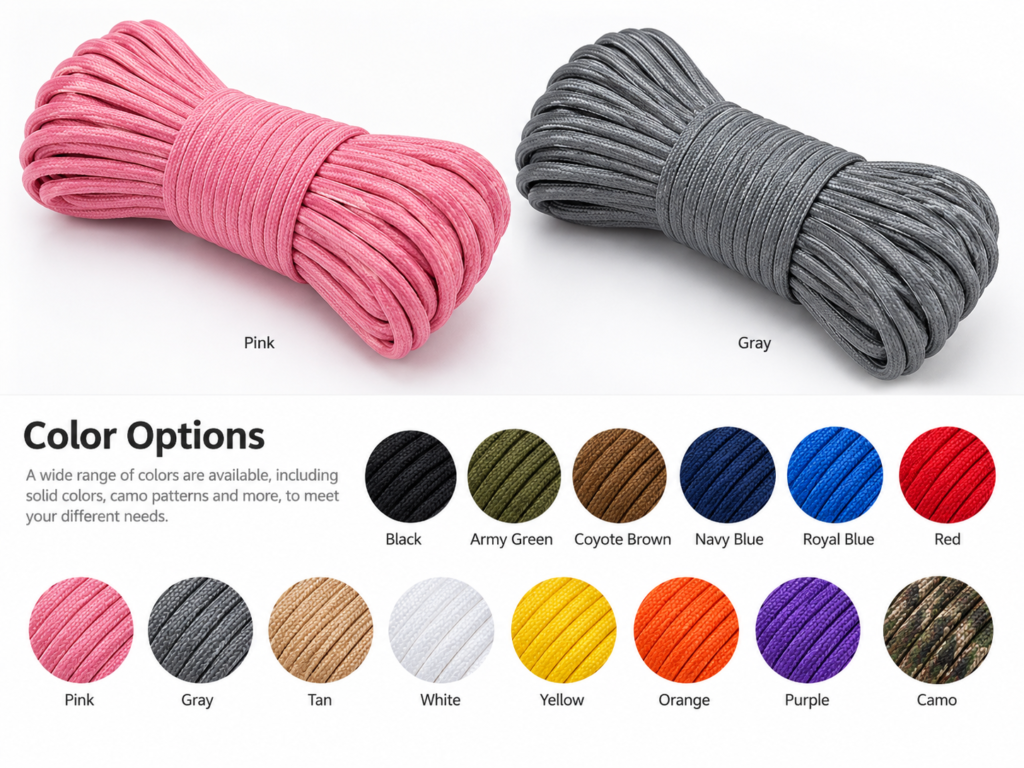
Colour-card samples are free and ship within 7 days. Transit time is additional.
Polyester and nylon samples are charged, since there is no stock cord to cut from. We don’t give a fixed dispatch time for them. For every sample, the buyer pays shipping.
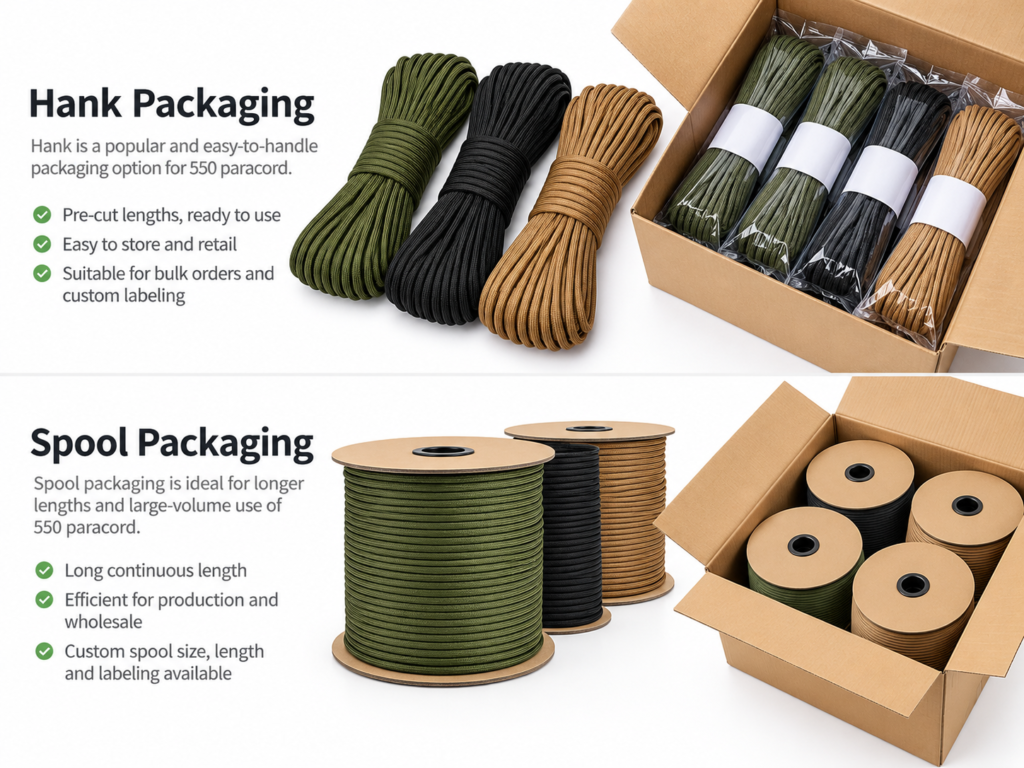
Paracord comes in a hank/bundle or on a spool. Tell us the length per hank or spool you need and we’ll confirm it in the quote. Packing tips are in packaging and storing paracord.
Fibre, dye method, construction and weight all change the cost, and heavier cord costs more to ship. That’s why I’d always compare quotes on the same spec, not just the same name.
If you’re torn between two fibres, ask for both on one quote. Send:
That’s enough for a clean comparison. For more on picking a supplier, see how to choose a paracord manufacturer.
Pick nylon for feel, polyester for low stretch and colour hold, PP for weight, floating and cost. Then check the MOQ for that fibre before you plan colours.
We have made paracord for over 15 years. We have ISO 9001 certification, and our PP and polyester rope each have an SGS REACH SVHC test report. Send your spec through our paracord manufacturer page and we reply within 12 hours.
Is polyester paracord as strong as nylon? Our 550 paracord is 550 lb rated in nylon, polyester and polypropylene. The main difference is stretch: nylon gives more, polyester less.
Does polypropylene paracord float? Yes. PP floats. Nylon and polyester sink.
What is the difference between nylon and polyester paracord? Nylon stretches more and feels softer. Polyester stretches less and holds colour better in sun.
Does 550 paracord meet a military standard? The 550 name comes from MIL-C-5040H, Type III. It describes where the name started. We make no military-standard claim for our cord.
What is the MOQ for paracord? 4 mm+ colour-card colours start at 100 ft per colour, 1,000 ft per order. Colours outside the card are 15,000 ft per colour. 2–3 mm polyester is 3,000 ft per colour. Nylon 4–10 mm is custom only at 15,000 ft per colour. Woven bracelets and accessories are 50 pcs per item.
Ready to source bulk paracord?
Tell us your target quantity, product style, and packaging requirements—
we’ll send you a detailed bulk quote within 12 hours.
ISO-9001-zertifiziert · Preise direkt ab Werk · Individuelle OEM-Fertigung möglich