Request a Quote
Tell us your product type, quantity, logo requirements, packaging needs, and destination country. Our team will reply within 12 hours to discuss your requirements and bulk quote.
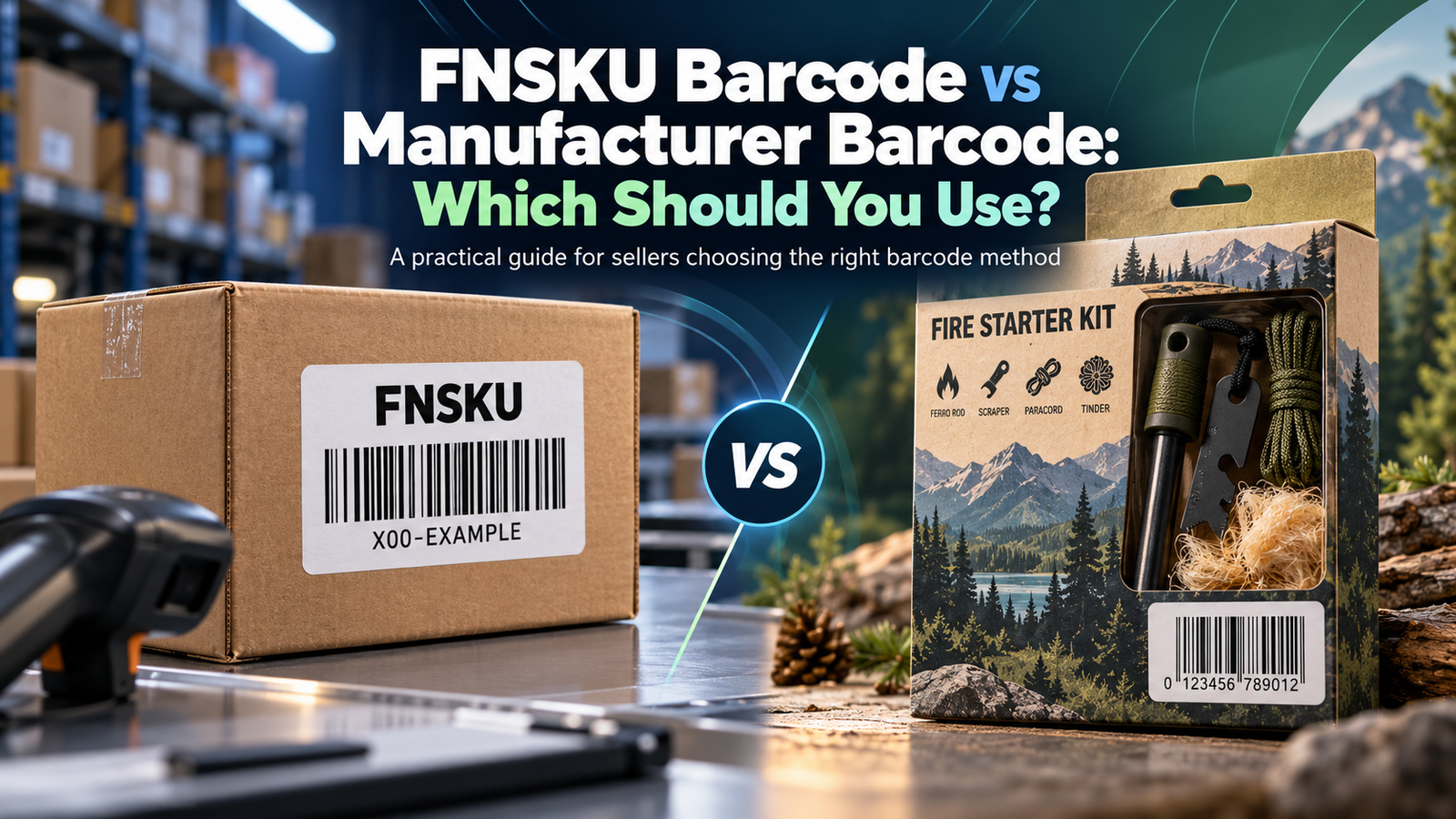
The FNSKU barcode is your unit label; see FNSKU labels explained. Choose the FNSKU barcode or manufacturer barcode that your seller role and product are eligible to use. Check current rules and product settings in Seller Central before printing labels or changing packaging for an FBA shipment.
Looking for a reliable ferro rod manufacturer for your brand? Compare factory pricing, MOQ options, and customization details before you commit.
No commitment · Reply within 12h · MOQ from 50 pcs
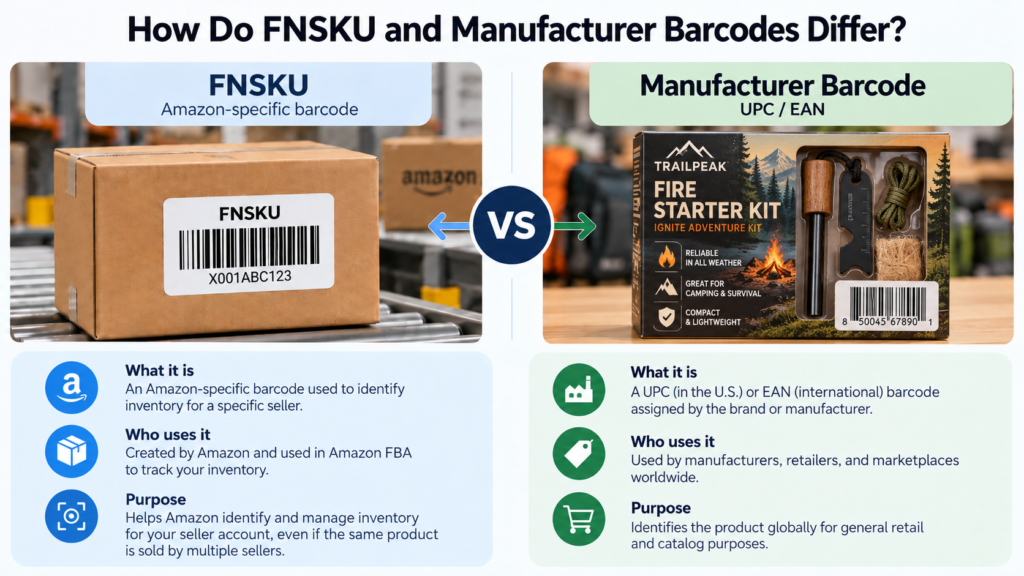
FNSKU barcode and manufacturer barcode do different jobs. The FNSKU is a fulfillment label tied to your seller account and a specific ASIN; the manufacturer barcode (UPC, EAN, ISBN) is a product identifier assigned at the brand or manufacturer level. They are not interchangeable in an FBA shipment, and neither one should be confused with your seller SKU or the ASIN itself.
| FNSKU barcode | Manufacturer barcode | |
| What it identifies | Your inventory as a specific seller’s unit inside Amazon’s fulfillment network | The product itself at the catalog or retail level |
| Who assigns it | Generated in Seller Central after the FBA listing is created | Issued by the brand or manufacturer, commonly through GS1 for UPC/EAN |
| Labeling action | A sticker or printed label is applied to each unit, covering existing scannable barcodes | No Amazon sticker is applied when the product is eligible; the existing barcode stays visible |
| Relationship to ASIN/SKU | Tied to your seller SKU and FBA listing; one FNSKU per sellable unit configuration | Linked to the product’s GTIN; multiple sellers may share the same manufacturer barcode |
| Use case | Required for resellers and for products not eligible for manufacturer barcodes | Available to eligible brand representatives for products that already carry a valid manufacturer barcode |
A simple way to remember the split: the manufacturer barcode says “what this product is.” The FNSKU says “whose unit this is in the fulfillment center.” If you are a reseller, Amazon needs the second answer. If you are an eligible brand representative, Amazon may let you rely on the first.
For a plain-language walkthrough of how FNSKU labels work in practice, see FNSKU labels explained.
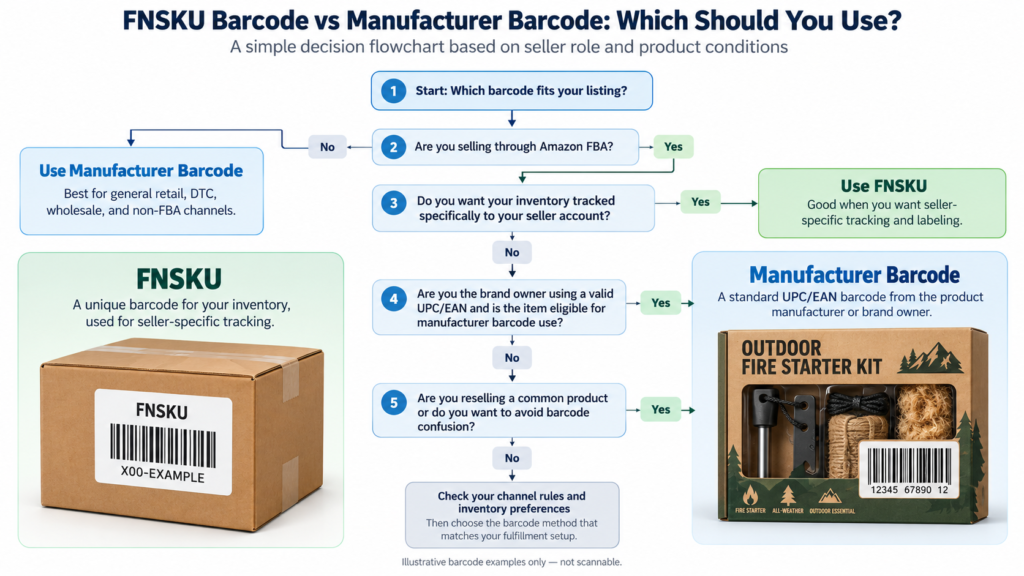
Three conditions determine eligibility. The table below is a starting point, not a replacement for Seller Central verification.
| Seller / product condition | Can manufacturer barcode be used without an FNSKU sticker? |
| Brand owner with the Brand Representative selling role in Brand Registry, and the product already has a manufacturer barcode | Yes, under the post-2026 rules, provided the listing and product settings reflect that role |
| Reseller — a seller not enrolled in Brand Registry as a Brand Representative for the brand | No. Amazon barcodes are required even if the product has a manufacturer barcode |
| Any seller whose product does not have a manufacturer barcode | No. An Amazon barcode is required for both brand owners and resellers |
“Has Brand Registry” is not the test. The test is the selling role: Brand Representative, not merely a registered brand or an authorized reseller. Amazon’s FAQ states directly that an authorized reseller cannot use stickerless inventory; the reseller must apply Amazon barcodes. Brand owners qualify because they hold direct responsibility for product quality and authenticity and procure GTINs directly from GS1, which gives Amazon a reliable identifier to track.
Product-level limits also apply. An ASIN may still be ineligible because of catalog data, barcode conflicts, or the product type itself. The eligibility decision is therefore a joint check: role plus product plus marketplace. Never treat “Brand Representative” as a blanket exemption for every product you sell.
No — the old shortcut is out of date. Before 2026, the practical advice was often simplified as “use UPC and your inventory may be commingled.” That is not the current framework.
Effective March 31, 2026, Amazon ended commingling across its supply chain and changed manufacturer barcode eligibility at the same time. For inventory shipped on or after that date:
The key point for procurement and packaging decisions is this: using a manufacturer barcode does not automatically put your inventory into a shared pool. The 2026 change separates the two questions. One question is whether you are eligible to use the manufacturer barcode without a sticker. The other is whether commingling applies to your shipment. Resellers are moved to FNSKU labeling not because their UPC is “commingled by default,” but because Amazon now requires Amazon barcodes for reseller inventory regardless of the product’s existing manufacturer barcode.
✓ Free samples available ✓ Custom logo & packaging ✓ We have ISO 9001 certification
Changing from FNSKU labeling to manufacturer barcode labeling, or the reverse, is a batch-level and account-level decision, not a single toggle that converts existing inventory. Before you change label files or packaging, work through the following checks in this order.
1. Confirm the destination marketplace. Barcode rules and product eligibility can differ by Amazon store. A label file prepared for one marketplace should not be assumed valid for another.
2. Review existing inventory and open shipments. Units already labeled with FNSKU and in transit or in the fulfillment network have their own status. A new labeling decision for future production does not retroactively relabel existing stock. Do not assume that changing a default setting in Seller Central converts units already on the floor.
3. Identify the exact replenishment SKUs. A brand may have a mixed catalog: some ASINs eligible for manufacturer barcodes, some not, and some variations with different barcode histories. Build a SKU-by-SKU eligibility list before briefing a supplier or printer.
4. Read the current Seller Central instructions for each listing. Seller Central shows the barcode setting and any product-level restriction that applies. Platform requirements and destination-country legal labeling rules are separate checks; Seller Central guidance is not a substitute for legal review, and legal compliance does not guarantee FBA eligibility.
5. Decide which label file applies to the next production batch. Once the role and product eligibility are confirmed, the output is a specific instruction: “apply FNSKU labels to every unit” or “do not apply FNSKU stickers; keep the manufacturer barcode visible.” That instruction should be tied to the batch, not left as a verbal default.
No one can promise that a barcode change alone will make every unit warehouse-ready. Shipment acceptance depends on the destination marketplace, the product, and current shipment requirements. Sellers must verify those conditions in Seller Central.
The supplier handoff is where barcode decisions become physical actions. A clear handoff prevents a factory from applying the wrong sticker, covering the wrong barcode, or assuming it can decide eligibility on the seller’s behalf.
If you source outdoor products from Survfire, FNSKU labeling is available as a pre-shipment step. Survfire has operated its own factory since 2010. We have ISO 9001 certification. For sellers using FNSKU, the handoff can specify FNSKU labeling for the outdoor products you source from us, alongside boxing, packing lists, and export cartons. Survfire does not provide Amazon FBA fulfillment, and ISO 9001 certification is a quality management certification, not an Amazon authorization or partnership. Supplier replies are within 12 hours. Custom samples are produced within 7 working days. Standard production runs 7–15 working days, with transit time quoted separately.
Product purchase MOQ is from 50 pcs per SKU. This MOQ applies to product procurement, not to labeling services as a separate commitment. For private label options, including packaging and logo work, review the private label options before finalizing the barcode handoff.The supplier can execute the labeling instruction. The seller must own the eligibility decision, verify the destination marketplace, and confirm that the label file matches the current Seller Central requirement for each SKU.
Q: Do all FBA sellers need an FNSKU sticker?
A: Not all sellers and products have the same eligibility. Confirm your selling role and the product’s barcode requirements in Seller Central before preparing inventory.
Q: Can resellers rely on a manufacturer barcode for new US FBA shipments?
A: For inventory shipped on or after March 31, 2026, Amazon requires resellers without the Brand Representative selling role to use Amazon barcode labels, even when a manufacturer barcode exists.
Q: Does Brand Registry enrollment alone remove labeling requirements?
A: No. The relevant selling role, product eligibility, and availability of a manufacturer barcode also matter. Check the current requirements for each product.
Q: Can my supplier decide the barcode type for me?
A: Your selling account determines eligibility. Give the supplier your confirmed barcode instructions and the matching label files before production or packing.
We have ISO 9001 certification · Direct factory pricing · Custom OEM available